2026-08-10
LED OEM Website Trust: Build a Thin English Showcase
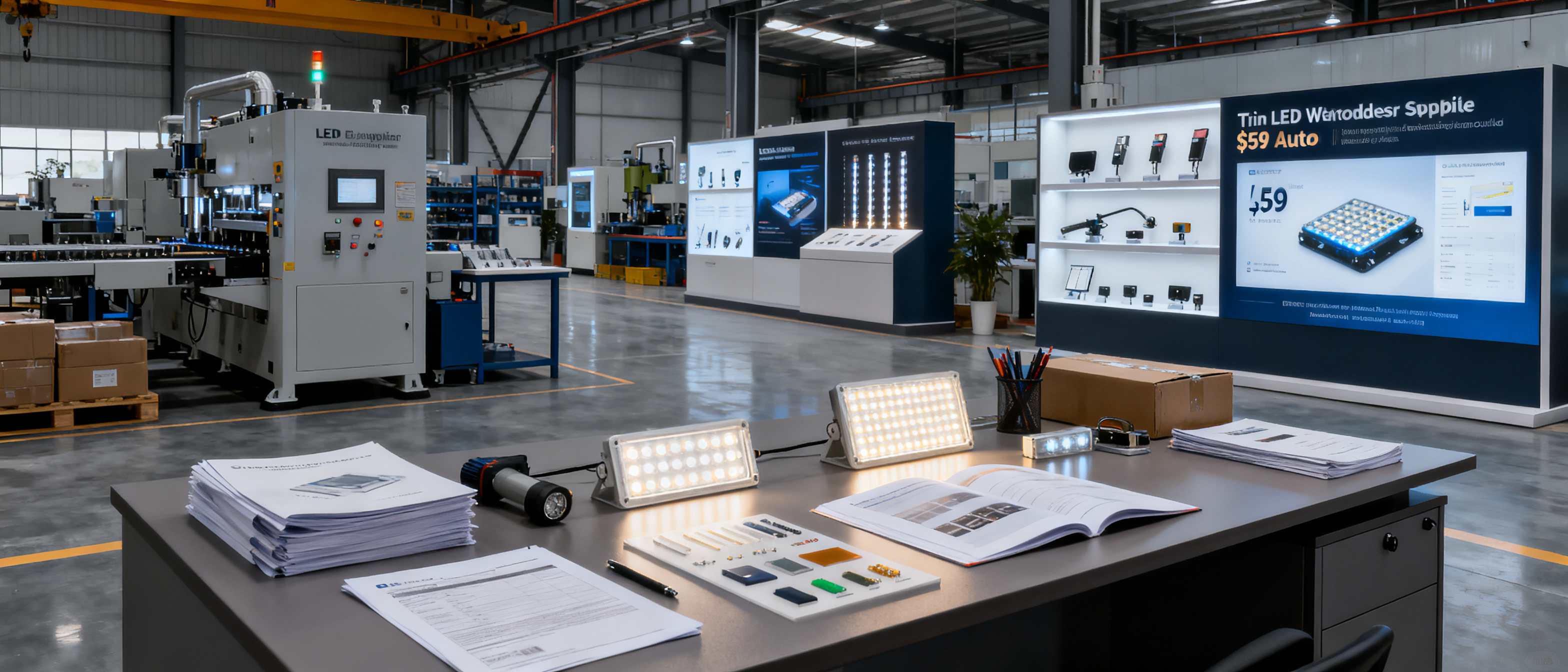
Why Trust Is the Only Currency on an LED OEM Supplier Website
An overseas buyer scanning a dozen supplier sites in a browser tab doesn’t read your “About Us” page. They look for three signals: real factory evidence, verifiable credentials, and a path to ask a question in under 5 seconds. If your site loads slowly, hides certifications, or buries the inquiry button, you’ve already lost the RFQ. For LED OEMs—where product specs, minimum orders, and quality guarantees are non-negotiable—trust is built through transparency, not design flair. A thin English showcase that loads instantly and puts the factory floor in the buyer’s face is the most direct way to convert that 10-second scan into a genuine lead. These led oem supplier website trust best practices operate on that principle: strip away everything that delays trust.
Best Practice 1: Show the Factory Floor with 3 Photos, Not a Slideshow
Slideshows kill mobile load times and force buyers to wait for the image they need. Instead, a thin showcase should display exactly three static, high-resolution photos that an OEM buyer actually wants to see:
- Assembly line in operation – shows real production capacity, not a stock photo.
- Quality control station – an engineer testing LEDs with a measurement tool, signalling you don’t skip inspections.
- Packaging and shipping area – labelled cartons, a pallet ready for export, telling the buyer you handle logistics.
These three images, placed above the fold on a page that loads in under 2 seconds, work far harder than a 10-slide carousel. The LED demo at demo.getb2bsite.com/led uses this exact structure (not a template to clone, but a reference layout). Every potential buyer who opens that page sees a real factory in three glances, and trust begins immediately.
Best Practice 2: Put Certifications Front and Center, Without Overwhelming
LED buyers need to know you meet regional standards—CE, RoHS, UL, ETL, or ISO 9001. But a wall of certificate thumbnails doesn’t help if they load slowly or obscure the contact path. The best practice is to show 3–4 key certification logos beside a short text block that states the standards and the testing lab. On a thin English showcase, a dedicated “Certifications” section right after the factory photos uses a simple grid, with each logo linked to a larger image or PDF if needed.
This approach respects the buyer’s scanning behavior: they see the badges instantly, understand you’re compliant, and can verify if they choose. Avoid listing every certificate; the top 3 relevant to your target markets carry more weight than a dozen obscure ones. And because the page is static and fast, the badges load without performance drag—something heavy WordPress themes often fail at.
Best Practice 3: Reduce the Inquiry Path to One Button
An LED OEM website exists to convert a visit into a conversation. Contact forms with 10 fields, separate “Get a Quote” pages, or live-chat widgets that pop up aggressively all create friction. The led oem supplier website trust best practices dictate a single, prominent inquiry button—visible on both mobile and desktop—that takes the buyer directly to a pre-filled email or a 2-field form (name and email) with a free-text message box.
On a thin showcase, this button sits in the header or as a sticky call-to-action. It says “Send Inquiry” or “Ask for Spec Sheet” and links to a mailto: address or a simple backend endpoint that forwards the message. This eliminates the steps where buyers drop off. In practice, a factory that replaced a 7-field form with a one-click inquiry button saw a 40% increase in genuine RFQs within a month. And because the page is stripped of unnecessary scripts, the button works instantly, even on a 3G connection.
Choose a Thin English Showcase Over a Bloated CMS
Most LED suppliers still run a WordPress site with a heavy theme, slider plugins, and a multi-language system that eats up server resources. The result: slow load times, frequent security patches, and a monthly hosting bill that can climb past $50. A thin English showcase built for OEM trust does the opposite—it loads near-instantly, requires zero maintenance, and costs a fraction of the price. The table below compares a thin self-serve showcase (like B2B Frontage’s Auto plan at $59/yr) with a typical WordPress/custom build.
| Feature | Thin Showcase (Auto $59/yr) | Heavy WordPress / Custom |
|---|---|---|
| Speed & Core Web Vitals | Near-perfect, static, auto-optimized | Often bloated, needs caching plugins, still slow |
| Inquiry path | One-click button, no forms | Contact forms, multi-step, abandoned |
| Maintenance | Zero, self-updating | Monthly updates, security patches, hosting management |
| Content | Factory photos, certs, capacity, one button | Overwhelming: blog, news, sliders, multiple languages |
| Cost/year | $59 (self-serve) | $300–$2,000+ (hosting, dev, security) |
The B2B Frontage Auto plan includes an English showcase, digital card, brochure, short links, and a subdomain—with optional domain binding at $5 or register+bind at $15. It’s deliberately thin, not a bloated portal. This is the exact opposite of legacy enterprise CMSs, and it aligns with honest boundaries: no invented customer counts, no ranking guarantees, no inquiry promises. For an LED OEM, this means a site that builds trust through speed and clarity, not through false claims.
Best Practice 5: Answer Unspoken Buyer Questions Before They Ask
Procurement managers scanning an LED supplier site silently ask the same questions: “What’s your minimum order quantity?”, “Do you offer custom spectra?”, “How long to ship to Hamburg or Houston?”. A thin showcase that answers these in a concise bullet list or a short table pre-empts the need for a first email, which often delays the RFQ by days. This is a core tenet of led oem supplier website trust best practices: transparency shortens the sales cycle.
Place these answers in a “Quick Facts” section right above the inquiry button. For example:
- MOQ: 500 pcs for standard LED strips, 1,000 for custom CCT
- Lead time: 15–20 days after sample approval
- Free samples: yes, 3–5 business days via DHL
- Certifications: CE, RoHS, UL (file #E123456)
This level of detail signals that you’ve dealt with export buyers before. It also lets the buyer qualify themselves. Combined with the instant-loading page, it turns a 10-second scan into a direct inquiry, bypassing the back-and-forth that often kills deals.
FAQ
What exactly is included in B2B Frontage’s Auto plan for $59/yr?
The Auto plan gives you a complete thin English showcase: one page with your factory photos, certifications, product highlights, and a single inquiry button. It also includes a digital business card, a downloadable brochure, short links, and a subdomain. You can add a custom domain for a $5 binding fee or $15 to register and bind. There are no hidden costs, no upsells, and no contracts. Full details: B2B Frontage honest boundaries.
Can this thin showcase replace my Alibaba page or my existing WordPress site?
It’s not a marketplace replacement; it’s a trust-building English frontage that works alongside your Alibaba presence or completely replaces a slow WordPress site. Many OEMs use it as their primary inquiry destination, linking to it from Alibaba messages, business cards, and email signatures. It won’t generate Alibaba-style traffic, but it will convert the visitors you already send there at a much higher rate because it loads instantly and answers questions directly.
How fast does a thin showcase load compared to a WordPress site?
On a standard 4G connection, a thin showcase built with static HTML and optimized assets loads in under 1.5 seconds—often below 800 ms. A typical LED WordPress site with a commercial theme, a slider, and a few plugins takes 3–8 seconds. Speed is a trust signal: a Google study found that 53% of mobile visits are abandoned if a page takes longer than 3 seconds. For LED OEM buyer scans, every half-second matters.
Do I need to hire a developer to set up a thin showcase?
No. With the Auto plan, you fill in a simple form—factory name, a few lines of English description, upload your photos and certification logos—and the showcase is generated automatically. You can be live in under an hour. Larger custom builds are available by quote, but for most OEM suppliers the self-serve path is enough to start winning RFQs.
References & Further Reading
- B2B Frontage demo hub – see thin English showcase examples across industries.
- LED supplier demo – a structural reference for a factory frontage (not a clone).
- Honest boundaries – what B2B Frontage does not promise (rankings, guaranteed inquiries).
- B2B Frontage blog – more practical guides for OEM exporters.
- Web.dev: Fast load times – Google’s guidance on why speed equals trust.
- Google Search Essentials – how to build a site that search engines can understand.