2026-08-07
If Your Factory Website Ranked on Day One, Would Alibaba Still Matter?
If Your Factory Website Ranked on Day One, Would Alibaba Still Matter?
Every factory owner who Googles "factory website vs Alibaba" eventually lands on the same uncomfortable question: if my own site could pull inquiries the way a marketplace does, why would I keep paying annual membership fees? The short answer, before we unpack the nuance, is that ranking on day one would change the math entirely—but it rarely happens, and chasing that fantasy often leaves factories with nothing. For Chinese OEMs, export factories, and overseas small-batch manufacturers who just need a thin English showcase, the real opportunity sits between the two extremes: a lightweight, honest factory frontage that costs less than a single platform subscription and does exactly what platforms cannot.
What small factories really ask when they hear "build a website"
When an export factory manager hears "build a website," the mental image is rarely a custom-coded business card. It is usually a miniature Alibaba—a site that ranks on Google, attracts international buyers, and generates inquiries without the 6–12% commission or annual Gold Supplier fees. That expectation is widespread and completely understandable. After all, if a $3,000-per-year marketplace membership buys visibility, why wouldn't a one-time website investment buy the same thing permanently?
The reality engineers at B2B Frontage hear this conversation weekly. A packaging factory in Guangdong wants "something like our Alibaba store but cheaper." A metal fabrication SME in Vietnam asks whether a WordPress site can "replace Made-in-China." Underneath every question is the same hope: that owning a domain means owning the traffic. The factory website vs Alibaba debate, stripped of jargon, is really a debate about whether manufacturers can bypass intermediary platforms entirely—and the answer depends entirely on how quickly a site can earn visibility, trust, and inquiry momentum.
If ranking and inquiries arrived on day one, platforms would be optional
Let us take the thought experiment seriously. Imagine a factory website that, from the moment it goes live, ranks on page one of Google for its target product keywords. Imagine it receives five to ten genuine buyer inquiries per week. In that scenario, Alibaba, Made-in-China, and Global Sources become optional marketing channels—nice to have, not essential. The factory would save membership fees, avoid commission structures, control its own buyer data, and never compete with 40 other suppliers inside the same product listing.
But this scenario requires three things that almost never arrive simultaneously: instant domain authority, perfect on-page SEO, and a steady stream of quality backlinks. Google's algorithms do not award trust on day one. A brand-new domain, even with excellent content, typically sits in the "sandbox" for months before competitive keywords begin to move. The factory website vs Alibaba comparison, viewed through this lens, is not a fair fight—Alibaba spends millions on domain authority, technical SEO, and paid acquisition. A standalone factory site starts from zero.
This is where the honesty boundary matters. B2B Frontage builds thin English showcases—fast, clean, technically sound—but we never promise rankings, inquiry volume, or customer counts. The #rules page states this plainly because the expectation gap is the real enemy. A factory that understands its website will not outrank Alibaba on day one makes smarter decisions about where to invest time and money.
What Alibaba and Made-in-China are actually paid to do
Marketplaces are not selling websites. They are selling buyer traffic, trust infrastructure, and transaction facilitation bundled into a single interface. When a factory pays Alibaba $3,000–$8,000 per year for a Gold Supplier membership, the fee primarily covers:
- Aggregated buyer traffic: Millions of procurement professionals visit Alibaba monthly. The platform invests heavily in Google Ads, SEO, trade shows, and retargeting to bring buyers to the marketplace—not to individual supplier storefronts.
- Trust signals: Verified supplier badges, Trade Assurance, on-time delivery rates, and third-party inspection reports create a baseline of buyer confidence that a standalone site cannot replicate overnight.
- Inquiry routing: The platform's internal search algorithm matches buyer queries to supplier listings, distributing inquiries across competing factories. This is both a benefit and a frustration—you get exposure, but you share it.
- Transaction infrastructure: Escrow payments, RFQ management, and messaging tools reduce friction for first-time buyer-supplier interactions.
These functions are expensive to replicate independently. A standalone factory website would need to invest in SEO, paid search, trust badges, case studies, and possibly a CRM integration to approximate what a marketplace delivers out of the box. The factory website vs Alibaba question, when framed honestly, is not about whether one replaces the other—it is about which functions each channel performs best, and at what cost.
What a thin English factory website is for (and what it is not)
A thin English factory showcase—the kind B2B Frontage builds—serves a specific purpose that marketplaces do not address. It is a digital frontage: a clean, permanent, verifiable presence that lives on the factory's own domain. It is not an Alibaba replacement, not a bloated WordPress CMS with 47 plugins, and certainly not a machine designed to capture Google traffic at scale.
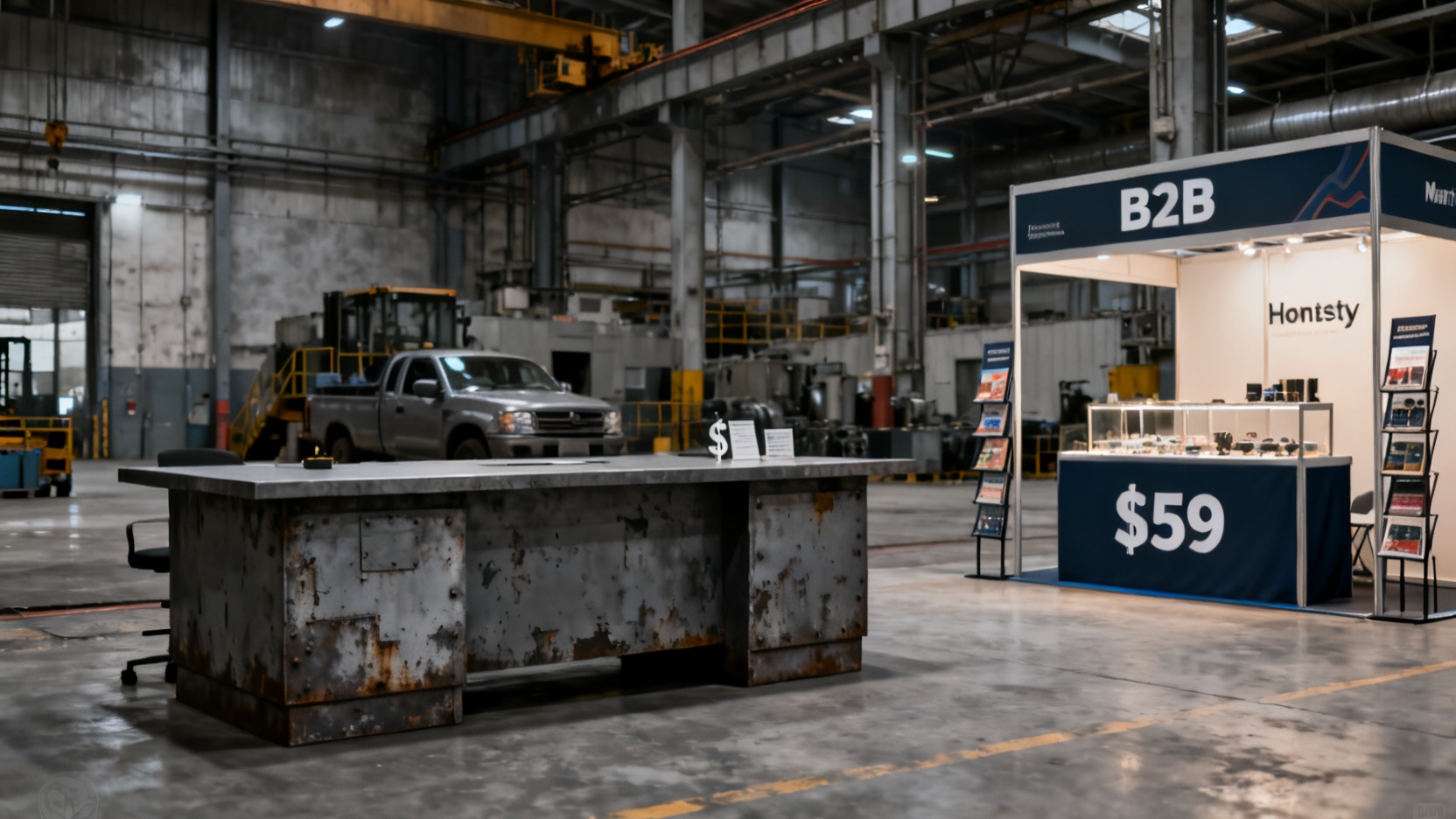
Here is a quick comparison of what a thin Auto showcase at $59/yr includes versus the expectation of "ranking like a marketplace":
| Thin English Showcase (Auto $59/yr) | Expecting Google Traffic Like Alibaba |
|---|---|
| One-page factory frontage with product overview | Multi-page SEO-optimized content hub |
| Digital business card + brochure PDF | Blog, case studies, industry articles |
| Short links for WeChat/WhatsApp sharing | Backlink profile from industry publications |
| Subdomain included; domain assist optional | Custom domain with years of authority building |
| Honest positioning: trust layer, not traffic engine | Unrealistic expectation of page-one rankings |
| Live in hours, not weeks | Months to years of SEO investment |
The thin showcase answers a different question. It says: "This factory exists, here is what we make, here is how to contact us, and here is a brochure you can download." When a buyer finds you on Alibaba and then searches your company name, a clean English frontage at your own domain signals legitimacy. It is the difference between a supplier who only exists inside a marketplace and one with an independent, verifiable presence. You can see exactly how this structure works on the B2B Frontage demo hub or explore a specific industry example at the packaging factory demo.
A practical split: discovery on the platform, trust on your domain
The most effective factory marketing strategy we observe is not factory website vs Alibaba, but factory website with Alibaba. The marketplace handles discovery—bringing unfamiliar buyers into the funnel through aggregated search traffic and internal recommendation algorithms. The standalone website handles trust and verification—giving those same buyers a permanent, unbranded (by the platform) destination to confirm the factory's legitimacy before sending a deposit.
This split maps cleanly onto budget and expectations. A factory might spend $3,000–$8,000 annually on marketplace membership for discovery and inquiry routing. Separately, it spends $59 per year on a thin English showcase that lives at its own domain, carries no competitor listings, and remains online regardless of marketplace subscription status. The B2B Frontage blog covers variations of this setup for different industries, but the core logic remains the same: platforms are rented audiences; your own domain is owned credibility.
For overseas small-batch manufacturers and SME workshops, the calculus is even clearer. Many cannot justify a full Alibaba Gold Supplier membership. A thin showcase—paired with LinkedIn outreach, trade show contacts, or direct email—provides a professional destination to send prospects without the cost and complexity of a full marketplace presence. The $59/yr Auto tier from B2B Frontage includes a showcase, digital card, brochure, and short links, with a subdomain included and optional domain assistance at checkout. Larger CMS or custom builds are available by quote, but the Auto tier deliberately stays small, fast, and honest about what it delivers.
FAQ
Will a thin factory website get traffic from Google?
A thin English showcase is not built for competitive SEO traffic. It may rank for your exact company name or very specific long-tail phrases over time, but it will not compete with marketplace domains for generic product keywords. The site's job is to exist when someone searches for your factory by name—after they have already found you elsewhere. Google's SEO starter guide explains the months of consistent effort required for competitive rankings, which is precisely why we separate the showcase function from the traffic-generation function.
Can a factory website replace Alibaba completely?
Only if the factory builds its own traffic engine—through SEO, paid ads, trade show lead generation, or an existing buyer network. For most small and medium factories, the marketplace provides discovery that a standalone site cannot replicate at a comparable cost. The factory website vs Alibaba question is better reframed as: how do these two tools work together? The marketplace finds new buyers; the website confirms the factory is real and trustworthy.
What exactly does the $59/yr Auto tier include?
The Auto tier from B2B Frontage includes a thin English showcase page, a digital business card, a downloadable brochure PDF, and short links for sharing on WeChat, WhatsApp, or email. A subdomain is included at no extra cost, and domain name assistance is available as an optional add-on at checkout. It does not include multi-page CMS functionality, custom design, SEO guarantees, or inquiry volume promises. Those boundaries are documented on the #rules page.
How long does it take to set up a thin showcase?
Most Auto tier showcases go live within hours once the factory provides basic information—company name, product categories, a few photos, and contact details. There is no complex CMS setup, no plugin configuration, and no multi-week development cycle. The speed comes from keeping the scope deliberately small and focused on the essential trust-building elements a buyer needs to see.
Do I need a custom domain, or is the subdomain enough?
The included subdomain works perfectly for sharing via short links and appearing professional when a buyer searches your company name. A custom domain adds an extra layer of brand ownership and is recommended if you plan to print the URL on business cards, catalogs, or trade show banners. Domain assistance is available at checkout for those who want it, but it is entirely optional.
References & Further Reading
- B2B Frontage Demo Hub — See the thin showcase structure in action
- Packaging Factory Demo — Industry-specific example of a factory frontage
- B2B Frontage Honest Boundaries — What we build and what we never promise
- B2B Frontage Blog — More articles on factory websites and digital presence
- Google Search Central — SEO Starter Guide — Understanding how search visibility actually works
- web.dev Performance Scoring — Why lightweight sites outperform bloated alternatives