2026-08-20
Website Builder vs Custom Development: Factory Site Decision
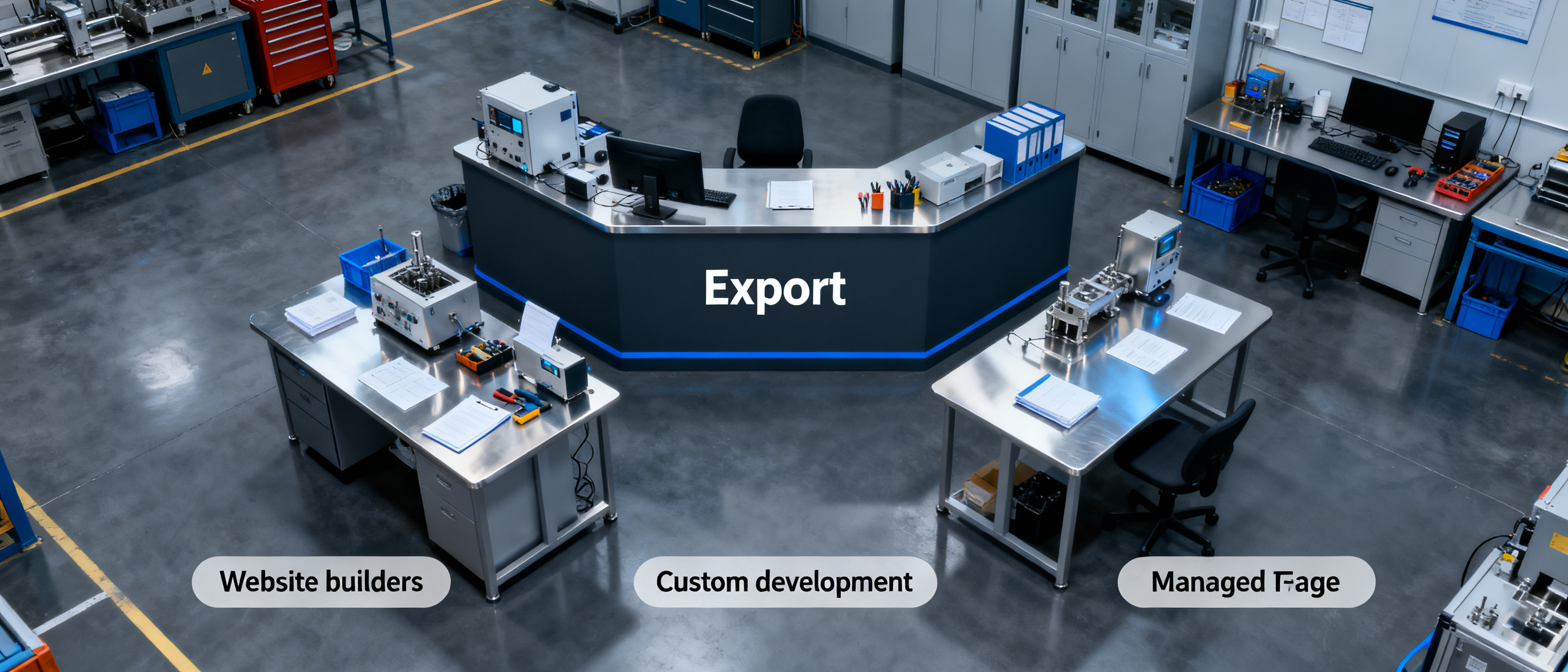
If you’re weighing website builder vs custom development for your factory’s English site, the right choice depends on whether you need a flexible design canvas or a low‑maintenance, trustworthy showcase. Most export factories and OEM desks don’t need a complex build. They need a thin, buyer‑friendly presence that buyers can scan in seconds—and that you can keep alive without a web team.
Website Builder vs Custom Development: What a Builder Can Do for an Export Factory
A website builder like Wix, Squarespace, or WordPress.com gives you a drag‑and‑drop canvas, hundreds of templates, and enough flexibility to build a multi‑page site without coding. For an export factory, that means you can quickly assemble an English‑language presence with a homepage, product pages, and a contact form. Many builders also offer SEO basics, SSL, and hosting bundled in plans that range from $15 to $45 per month.
But that freedom comes with a catch: you’re handed a blank canvas and a set of decisions. You choose the layout, the fonts, the image sizes, the navigation structure, and the exact wording—all while trying to guess what an overseas buyer will trust in a 10‑second scan. The result is often a site that looks like a generic template, or one that never gets finished because the export manager doesn’t have the time or design instinct to fill the canvas.
For a thin B2B showcase, a builder is often overkill. You’re paying for features you won’t use (blog, e‑commerce, membership) and still need to handle updates, backups, and content tweaks yourself. A builder works well when you want full design control and are willing to invest hours every month maintaining it. For many trade managers, that’s a distraction they can’t afford.
When Custom Development Makes Sense for Manufacturers
Custom development—hiring an agency or freelancer to code a site from scratch—is the right path when a factory has specific, complex requirements that no off‑the‑shelf tool can handle. Think: real‑time ERP integration for inventory, a custom product configurator, multi‑vendor quoting portals, or a compliance document library that needs to meet exact industry standards. If your business relies on a seamless digital experience that must be unique, a custom build can be worth the $5,000 to $30,000+ investment.
But custom development isn’t a one‑time cost. You’ll need ongoing maintenance, security patches, hosting management, and content updates—often requiring a retainer with the same agency or a dedicated in‑house resource. For a factory that just needs a credible English frontage, custom development is like building a factory when you only need a showroom. It’s expensive, slow to launch, and locks you into a relationship you may not need.
That said, if you’re a manufacturer with a unique value proposition that requires a heavily branded, interactive experience, and you have the budget and team to support it, custom development is the only way to get exactly what you want. The key is to be honest about what you actually need, not what sounds impressive.
The Hidden Maintenance Burden: Who Keeps the Site Alive?
Whether you choose a website builder or custom code, the site doesn’t maintain itself. Plugins need updating, themes break, hosting renewals lapse, SSL certificates expire, and content becomes stale. For a factory export desk, the person who ends up “keeping the site alive” is often the trade manager, who has no technical background. That’s a hidden cost that rarely shows up in the initial price tag.
Consider these real‑world maintenance tasks:
- Updating WordPress plugins and theme files to avoid security vulnerabilities (an average of 5–10 updates per month).
- Monitoring Core Web Vitals and fixing page speed issues that can tank your Google ranking.
- Renewing domain, hosting, and SSL certificates, often across different providers.
- Adding new product lines, certifications, or export markets—simple text changes that never get done because logging into a CMS feels like a chore.
Google’s own guidance on SEO fundamentals emphasizes that a site must be fast, secure, and mobile‑friendly. These aren’t set‑and‑forget tasks. A builder makes them possible, but it doesn’t do them for you. Custom development requires you to pay someone to do them. Either way, the maintenance burden is yours.
Managed Frontage: A Third Path for Factory English Showcases
There’s a middle ground between the blank canvas of a builder and the heavy lift of custom development: a managed factory frontage. Instead of giving you a tool to build a site, a managed service asks for your business facts—company profile, main solutions, optional certifications, and product lines—and then assembles a thin, professional English showcase that’s ready for a buyer’s 10‑second scan. The platform handles hosting, security, updates, and even digital cards and brochures from the same set of facts.
This approach is opinionated. You don’t choose every pixel or menu item; the structure is pre‑decided based on what buyers actually look for on a supplier site. For example, a PCBA demo skin might show a clean, scannable layout with “Company,” “Solutions,” “Certifications,” and “Contact” sections—no more, no less. That’s a stark contrast to the near‑infinite decisions a builder forces on you.
B2B Frontage’s Auto $59 plan is one such managed service. It doesn’t compete with builders on feature count; instead, it removes the need to maintain anything. You provide the business knowledge once, and you get a live site, a digital card, and a brochure—all for $59 per year. It’s a pragmatic choice for factories that want a trustworthy English presence without hiring a web person or learning a builder. But it’s not for everyone: if you need a custom design, a complex CMS, or a blog, you’ll still need a builder or custom development.
To help you compare the three paths, here’s a quick overview:
| Factor | Website Builder | Custom Development | Managed Frontage |
|---|---|---|---|
| Typical cost | $15–$45/month + time | $5,000–$30,000+ upfront + ongoing | $59/year (Auto plan) |
| Setup time | Days to weeks (DIY) | Weeks to months | Minutes to hours |
| Maintenance burden | You manage everything | You pay someone to manage | None—platform handles it |
| Design freedom | Full control | Unlimited | Pre‑decided, opinionated |
| Best for | Those who want to tweak every detail | Complex, unique requirements | Thin, maintenance‑free export showcase |
As you can see, the website builder vs custom development debate isn’t the whole picture. If what you really need is a simple, credible presence that you can launch and forget, a managed frontage might be the smarter move.
FAQ
Can I still use a website builder if I just want a simple factory site?
Yes, you can. A website builder can definitely create a simple factory site. But you’ll still need to build it yourself, maintain it, and keep it updated. Many trade managers start with a builder and later realize they’re spending more time on site maintenance than on actual sales. If you’re comfortable with that ongoing commitment, a builder is a viable option.
How much does a custom‑developed factory website really cost?
A basic custom site for a manufacturer typically starts around $5,000 and can go well beyond $30,000 for complex, multi‑language portals with integrations. That’s just the initial build. Ongoing maintenance, hosting, and content updates can add $500–$2,000 per year. For a thin English showcase, that’s almost always more than you need.
What’s the difference between a managed frontage and a website builder?
A website builder gives you a blank canvas and a set of tools; you’re the builder. A managed frontage collects your business facts and assembles a pre‑structured site for you, then handles all the technical upkeep. With a builder, you’re the webmaster; with a managed frontage, you’re just the factory owner providing the right information once.
Will a managed frontage hurt my SEO?
No—a well‑built managed frontage can actually help your SEO by ensuring fast load times, mobile responsiveness, and clean, crawlable HTML without the bloat that often comes with heavily customized builders. Since the platform maintains the technical foundation, you won’t suffer from outdated plugins or broken rendering, which are common SEO pitfalls.