2026-08-21
Textile Factory Website: MOQ, GSM, OEKO-TEX Buyers Expect
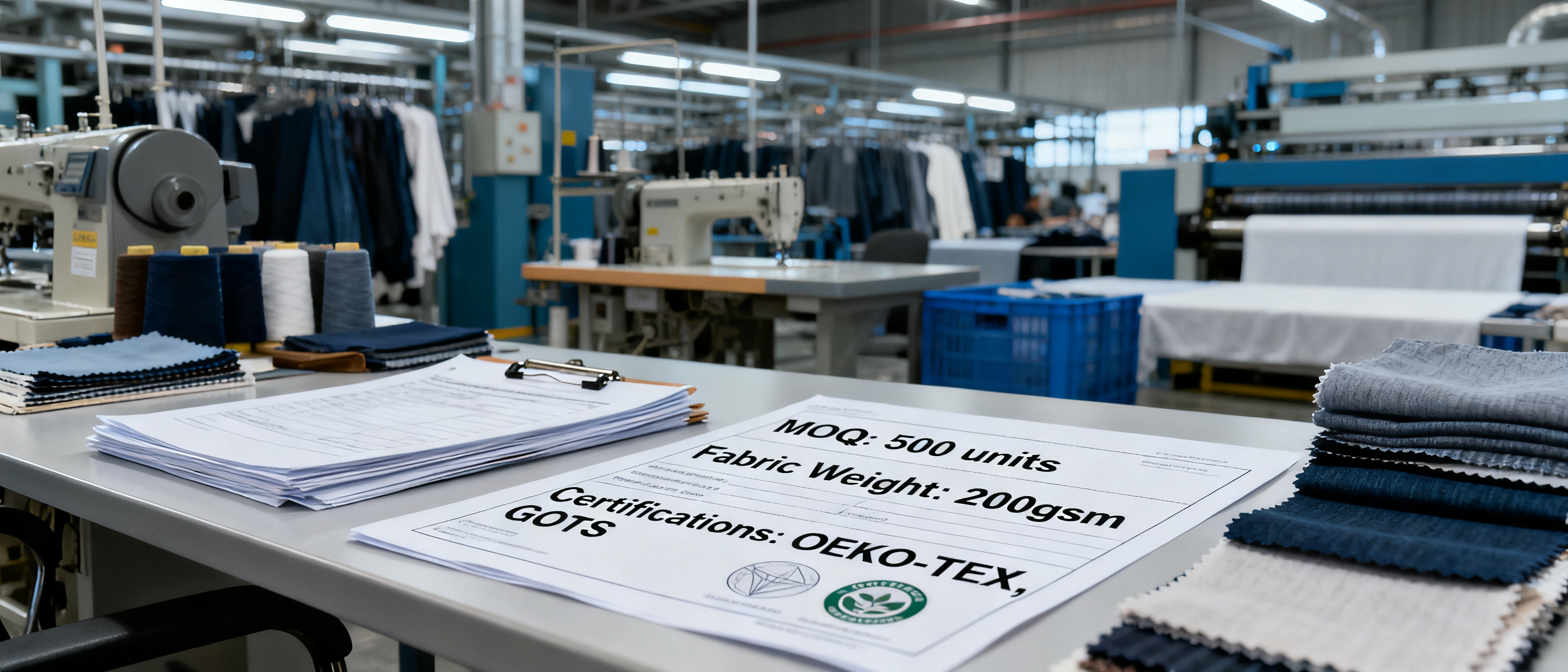
When a textile factory website clearly presents MOQ, GSM, and OEKO‑TEX certification, it answers the three cost‑and‑compliance questions buyers ask within seconds. A textile factory website moq gsm oeko‑tex buyers expect to see — not buried in a PDF but upfront on the product or capability page — can mean the difference between a quick inquiry and a bounce. This article explains what each of those signals means, how to display them correctly, and what else a serious factory page should cover.
Why MOQ transparency matters on a textile supplier site
Minimum order quantity is often the first deal‑breaker. A buyer looking for 300 custom‑dyed T‑shirts will leave if the site only shows “MOQ: 5,000 pcs.” Many export desks hide the number, hoping to negotiate, but that wastes time on both sides. On a textile factory website moq gsm oeko‑tex buyers expect to see clear, tiered MOQs: a standard range for stock fabrics (e.g., 500 m), a higher minimum for custom prints or yarn‑dyed designs, and perhaps a lower trial MOQ for first‑time buyers. Showing that you understand the tension between factory efficiency and buyer flexibility builds trust.
Practical ways to display it:
- List a base MOQ for each fabric category (cotton poplin, polyester fleece, etc.) right on the product card.
- Add a line like “Sample metre available; production MOQ from 1,000 m” so the buyer knows options exist.
- If you’re an OEM, separate MOQ for private‑label cut‑and‑sew vs. fabric‑only orders.
Many textile factory websites make the mistake of showing only the highest MOQ of the mill. A small ready‑stock quantity or a “sample yard” offer can be the hook that starts a conversation.
Decoding fabric weight: GSM and what it tells a buyer
GSM (grams per square metre) is the global shorthand for fabric weight and density. A buyer scanning a supplier site expects to see a GSM figure, not just “medium weight.” When a textile factory website moq gsm oeko‑tex buyers expect to find, GSM is the second number they check after the fibre composition. It tells them whether the t‑shirt will be a lightweight 130 GSM summer jersey or a sturdy 280 GSM fleece for a hoodie. Without it, the buyer cannot compare your offer to a competitor’s or to the sample they already have in hand.
Common GSM ranges that should appear on a textile factory’s spec sheet:
| Fabric / Use | Typical GSM range |
|---|---|
| Lightweight jersey (tees, linings) | 120–150 GSM |
| Single jersey / interlock | 160–200 GSM |
| French terry / mid‑weight sweatshirt | 240–300 GSM |
| Fleece‑backed / heavy hoodie | 300–400 GSM |
| Woven shirting (poplin) | 100–130 GSM |
| Denim (light to heavy) | 200–400+ GSM |
If your factory offers several weights, list them as a range per construction. Even better: couple the GSM with a photo of the fabric on a scale or with a coin for visual reference — buyers often double‑check weights from images.
OEKO‑TEX and other certifications that build instant trust
OEKO‑TEX Standard 100 is the minimum proof that a fabric is tested for harmful substances and safe for human use. For a textile factory website moq gsm oeko‑tex buyers expect to see the certificate logo, the certificate number, and a link to the valid check on the OEKO‑TEX website. A badge alone is not enough; buyers who source for European or North American brands will look up the number. If your site doesn’t show it, they assume the certificate is expired or not genuine.
Beyond OEKO‑TEX, other certifications that make a factory page credible include:
- GOTS (Global Organic Textile Standard) — essential for organic cotton or organic wool claims.
- GRS (Global Recycled Standard) — needed if you sell recycled polyester or other recycled fibres.
- BCI (Better Cotton Initiative) — common for cotton supply chains.
- ISO 9001 — generic quality management, still valued by institutional buyers.
- Reach / RoHS — for EU chemical compliance on accessories or coated textiles.
Place the certificate numbers and validation links on a dedicated “Compliance” page or footer, and repeat the most relevant ones on product detail pages. A textile factory website that treats certifications as a footnote misses the chance to make a buyer feel safe enough to share their spec sheet.
Additional specs buyers expect: lead times, sample policy, and production capabilities
Beyond MOQ, GSM, and certifications, buyers scanning a supplier site in under 30 seconds have a mental checklist. They expect to see:
- Lead time ranges — e.g., “15–25 days for custom dyed fabric, 7–10 days for stock greige.” Show the time from order confirmation to ex‑works, not from payment.
- Sample policy — free sample yard with courier charge, or paid sample cutting? Lab‑dip and strike‑off lead times. Buyers want to know if you can match their Pantone without a 30‑day wait.
- Production capacity — monthly yardage or garment pieces, number of knitting/dyeing/finishing lines, and whether you can handle large runs without subcontracting.
- Fabric construction and finishing options — yarn counts, weave types, brushing, anti‑pill, wicking, water‑repellent finishes. A single line like “we can do peach finish and anti‑static” can save a dozen emails.
- Payment terms — T/T, L/C at sight, or deposit‑balance split. Even a brief mention removes uncertainty.
These details are not “nice to have”; they are the signals a professional buyer uses to decide whether to add you to the shortlist. A textile factory website that addresses them without forcing the buyer to call or email is the one that gets the RFQ.
FAQ
What is a realistic MOQ for a small brand ordering custom‑dyed cotton jersey?
Many mid‑sized textile mills start at 500–1,000 metres per colour for custom dyeing. Some export‑oriented factories will accept 300 metres for a trial order if you pay a small surcharge. If you need less, look for stock‑service fabric suppliers or jobbers that hold greige and dye small lots.
How can I verify an OEKO‑TEX certificate on a supplier’s site?
Look for the certificate number below the OEKO‑TEX logo. Enter it on the official OEKO‑TEX label check at https://www.oeko-tex.com/en/label-check. If the certificate is valid, the system will show the product class, the scope, and the expiry date. If the supplier doesn’t provide a number, ask for it before proceeding.
Does a textile factory website need to list GSM for every product?
Yes, for any fabric or garment where weight influences the buyer’s decision. A lightweight scarf and a heavy sweatshirt both need a GSM figure. For accessories or trims you can skip it, but on the main fabric specifications it’s non‑negotiable. Buyers often filter by GSM when comparing suppliers, and missing the number puts you at a disadvantage.
Can I get a sample yard before placing a full MOQ order?
Most reputable textile factories offer a sample metre or a few sample yards, usually with the buyer covering courier costs. Some factories will refund the sample fee if you proceed to a production order. Clarify the sample policy on your website; a simple “free sample yard, courier at cost” reassures buyers that you’re open to verification.