2026-08-11
What Makes an Export Factory Website Inquiry Path Convince Buyers?
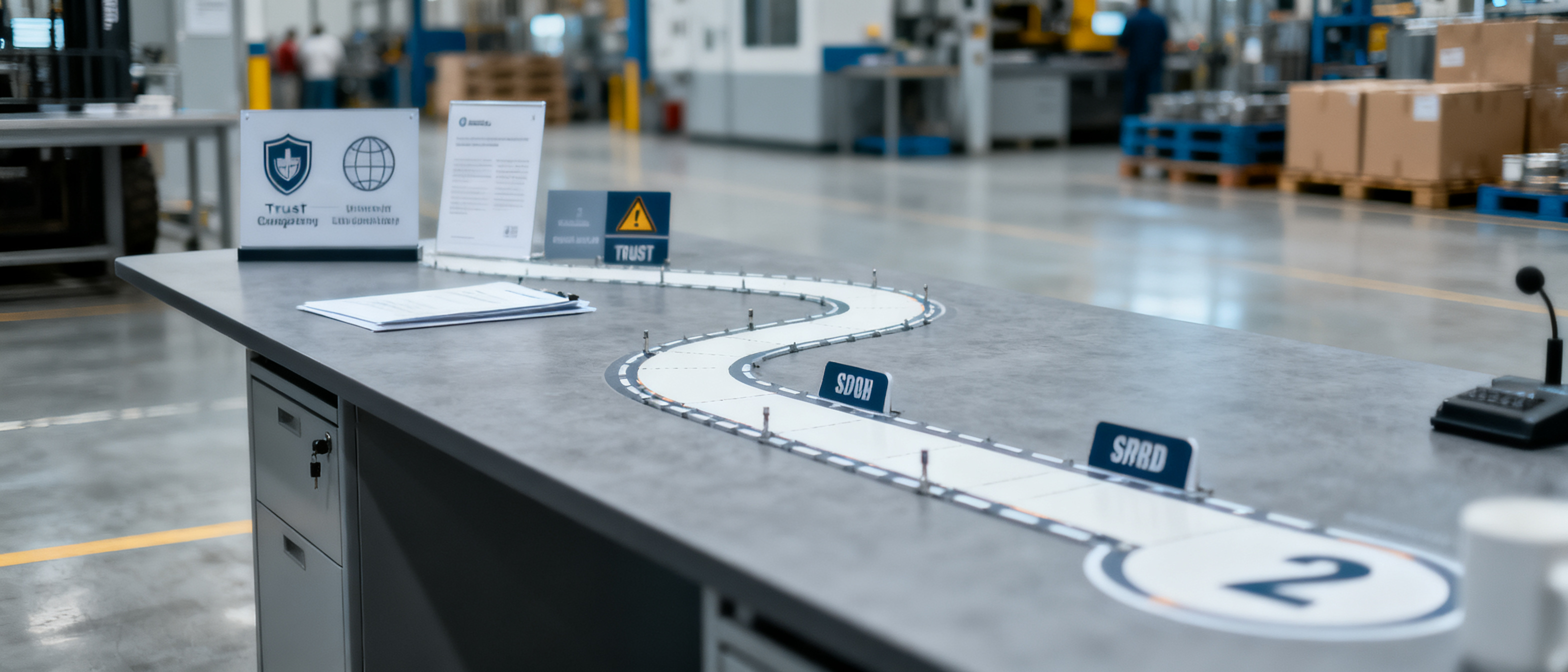
What makes an export factory website inquiry path convince buyers? It’s rarely the logo, the colour palette, or a long list of certifications. A sourcing manager or overseas buyer scans a supplier’s site in 10 seconds, mentally ticking off two or three trust items. The inquiry path—the sequence of hints, reassurance, and a frictionless ask—bridges that split-second verdict and a real lead. For an export factory or small OEM, the English showcase must be thin enough to load fast yet composed enough to signal that a real operation stands behind the page. That’s the space B2B Frontage fills with its thin-showcase approach and the Auto $59/yr plan: a lightweight, inquiry-ready English frontage that doesn’t pretend to be a bloated WordPress portal or an Alibaba store clone.
Why a Skeptical Buyer’s Scan Isn’t the End—It’s the Gate
A buyer who lands on an export factory website has usually already seen a dozen similar ones. Their first action is a rapid content scan: product photos, a recognizable factory image, a phone number or email, maybe a few specs. If those elements are missing or buried, the tab closes. But if those basics are present and clean, the buyer doesn’t become a lead—they simply stay long enough to ask the next question. The inquiry path is what converts that “staying” into a message. A thin showcase that puts a clear “Contact” or “Inquiry” button in the first screen, paired with a brochure or a short capabilities blurb, respects the buyer’s speed. It doesn’t force them to navigate through a five-page about-us story or a heavy CMS menu. B2B Frontage’s demo structure shows that a single-page scroll with a strategic inquiry anchor often outperforms a sprawling site, simply because the buyer’s scan gets answered before doubt creeps in.
The Inquiry Path Must Answer Three Unspoken Questions
Even after the scan, the buyer’s mind is weighing three things silently. If the path doesn’t answer them, the inquiry never happens.
- “Is this a real factory, not a trading shell?” A photo of the workshop floor, a mention of the production city, and the factory’s own email domain (not a free email) take seconds to process but carry enormous weight.
- “Can they make what I need?” A concise product list, a spec sheet PDF, or a one‑line capability statement (e.g., “knitted garments, 300,000 pcs/month”) is enough. The buyer doesn’t want a full catalogue; they want a signal that the scope matches their request.
- “What’s the next step without friction?” If the inquiry form asks for a 20‑field RFQ or hides behind a chat widget that only works during one time zone, the buyer will leave. A short form, an email link, or a WhatsApp number with a clear call‑to‑action makes the step feel safe and immediate.
What makes an export factory website inquiry path convincing is how quickly it hits these three notes. A thin B2B Frontage showcase, like the textile demo, deliberately surfaces a workshop photo, production capacity, and a one‑click inquiry strip in the first viewport. The buyer doesn’t need to hunt.
How the Textile Demo Skin Structures an Inquiry Path That Convinces
The Textile Demo on B2B Frontage’s demo hub is not a template to copy, but a reference for how a thin factory frontage can be assembled. Its structure runs like this:
- A hero section with a real factory image, a succinct tagline, and a prominent “Send Inquiry” button.
- A strip of three key numbers—annual capacity, minimum order quantity, and lead time—that answer the unspoken capability question.
- A product gallery with four to six crisp images, each linking to a short spec sheet or a digital brochure.
- A trust row: a photo of the QC team, a sample certificate, and a client logo bar (even if it’s just a few regional distributors).
- A compact inquiry form: name, email, message, and an optional upload field. No dropdowns about “how did you hear about us?”
- A footer with the factory’s verified email, phone, and a digital card link that recipients can save to their phone.
This path doesn’t rely on clever copy. It relies on structure and speed. The inquiry button is always within reach. The digital card turns a casual browser into a saved contact. Because the entire page is a thin showcase built on Next.js, it loads in under a second on a mobile browser, which matters when buyers are scanning on a 4G connection in a trade show aisle. The same structure works for a small OEM in Europe or a Chinese export desk—the trust signals are universal.
Auto $59 Plan: What the Inquiry Path Includes (and What It Won’t Do)
B2B Frontage’s Auto plan at $59 per year delivers a focused English showcase that contains the inquiry path essentials. Here’s what a factory owner gets:
- A single‑page thin showcase hosted on a fast subdomain (e.g.,
factory-name.getb2bsite.com). - A digital card with contact details that buyers can save or share.
- A PDF brochure upload and a set of short links for sharing the showcase on social media or email signatures.
- Optional domain assist at checkout: bind an existing domain for $5, or register + bind a new one for $15.
- All core trust signals—photo space, capability numbers, inquiry form—structured to convert a scanner into a sender.
But the plan has clear boundaries—and being honest about them is part of the trust. It does not promise a guaranteed number of inquiries, page‑one search rankings, or a replacement for a full Alibaba store. It is not a custom CMS portal; for larger factory sites that need dedicated product databases or multi‑language enterprise architecture, B2B Frontage provides a custom quote route. The #rules page states these boundaries plainly, so no buyer or seller is misled. The Auto plan is a thin, composed, inquiry‑ready frontage—not a marketing machine.
| Factor | Auto $59 Thin Showcase | Typical Heavy WordPress/Custom |
|---|---|---|
| Load time on mobile | ~1s or less | Often 3–8s, depending on plugins |
| Inquiry path clarity | Single page, one CTA, no menus | Multiple pages, varied CTAs, risk of distraction |
| Maintenance | Self‑serve updates, no security patches | Regular updates, plugin compatibility, possible downtime |
| Trust structure | Built‑in factory photo, capacity, digital card | Requires manual setup, often omitted |
| Cost | $59/year | $300–$1,200+ per year with hosting, maintenance, and developer fees |
The table isn’t a criticism of WordPress; it’s a recognition that the inquiry path for an export factory doesn’t need a multi‑engine. A thin showcase strips away the noise so the buyer’s three questions get answered before the bounce.
FAQ
Does the Auto $59 plan include the textile demo skin or can I copy it exactly?
The demo hub and the textile demo are structure references, not instant‑clone skins. You can use them to understand how to arrange your own content, but the plan doesn’t provide a one‑click copy of the demo. You’ll upload your own factory photos, product images, and text through the self‑serve dashboard, and the system will compose a similar thin showcase. The point is to keep your English frontage authentic, not a template duplicate.
How is this different from my Alibaba store or a free about‑us page?
An Alibaba store sits inside a marketplace where buyers compare dozens of suppliers side by side, often on price alone. Your B2B Frontage showcase is a standalone web property that you control—no third‑party branding, no competitor ads, and a direct inquiry path that leads to your own email. A free about‑us page on a blog platform often lacks the trust signals (factory photo, digital card, brochure) and may load slowly or look unprofessional. The thin showcase is designed to be the lightweight, inquiry‑focused frontage that you send to a buyer after a quick intro, or that a buyer finds when they search your factory name.
Can I add more pages or a product catalogue later?
The Auto $59 plan is intentionally a single‑page thin showcase. If you need a multi‑page product catalogue, a custom CMS, or a full enterprise site, B2B Frontage provides a custom quote route. The Auto plan keeps the inquiry path clean and fast—adding pages would reintroduce the complexity that most buyers skip. For many export factories, a single page with a digital brochure and a short link is enough to get serious inquiries, because the buyer just needs confirmation and a way to reach you.
What if I don’t get any inquiries after paying the $59?
The plan does not guarantee a specific number of inquiries, and B2B Frontage never invents customer counts or ranking promises. The showcase is a tool—a fast, composed English frontage—that removes the friction that often loses buyers. Whether you get inquiries depends on how you share the showcase (e.g., in email signatures, trade show QR codes, or when a buyer asks for a company profile), and on the inherent competitiveness of your product and pricing. The #rules page makes this clear: no guaranteed rankings, no guaranteed inquiries.
References & Further Reading
- B2B Frontage Demo Hub – see live thin‑showcase structures for different industries.
- Textile Demo – the specific inquiry‑path structure described in this post.
- B2B Frontage #rules – honest boundaries: what the product does and does not promise.
- B2B Frontage Blog – more articles on thin English factory frontages and buyer psychology.
- Why Speed Matters (web.dev) – Google’s research on how mobile load times impact bounce rates and conversion.
- Google SEO Starter Guide – fundamentals for structuring a page that search engines and humans can parse quickly.